
Industry Sponsored
Broker-centric CRM for
commercial real estate
A research-driven CRM reimagining how commercial real estate brokers manage leads, knowledge, and deals.
Duration
12 Weeks
My Role
Product Designer
UX research · Workflow design · Information architecture · Prototyping
Methods Used
Stakeholder interviews · Workflow mapping · CRM ecosystem analysis · Competitive benchmarking · Information architecture design · Iterative wireframing & prototyping · Cross-functional product reviews
The Ask
Deal Meridian wanted to rethink how commercial real estate brokers manage fragmented deal information. Brokers relied on spreadsheets, emails, and scattered documents, making it difficult to track leads and maintain deal visibility across teams.
The Goal
Design a broker-centric CRM that aligns with how brokers actually work, supporting lead tracking, deal progression, and knowledge capture within a single workflow system.
The Outcome
A research-informed CRM framework that centralises leads, deal data, and operational knowledge into one platform, reducing information fragmentation and enabling brokers to manage complex deals more effectively.
30+
Industry interviews with brokers, renters, and property owners driving product direction
6
Brokerage phases streamlined into 1 unified system
3
Core workflow challenges systematically identified and addressed
The problem at glance
Deals aren't linear. Tools treat them like they are. Commercial real estate transactions are long-running, non-linear, and deeply context-driven. They involve multiple stakeholders, evolving terms, and extended negotiations. Yet most CRM and PropTech systems model deals as straight sales pipelines, rigid stages, static fields, and simplified progression, forcing brokers to adapt their workflows to the tool, rather than the tool adapting to brokerage reality.
Despite growing investment in PropTech, digital tools have not made the same level of operational impact in brokerage as in other areas of real estate. - SIOR, 2025
What the brokerage journey actually looks like
Commercial real estate deals unfold gradually through a series of relationship-driven interactions. What begins as an initial lead evolves through conversations, site visits, negotiations, and coordination between multiple stakeholders. Each stage builds on the previous one, with brokers continuously gathering information, aligning expectations, and shaping the terms until closure and eventual handoff.

The Preference Mapping stage consistently emerged as the most underserved part of the journey. No existing tool helped brokers track how client preferences evolved over time. Everything depended on the broker's memory, and memories degrade over a 3 to 12 - month deal cycle.
Where things start to break
Through desk research, semi-structured interviews with brokers across urban India, and analysis of how they used existing tools, three consistent pain points emerged regardless of firm size, city, or experience level.
Critical information is spread across emails, spreadsheets, WhatsApp, and personal notes, making it difficult for brokers to retrieve accurate context quickly. Brokers switch between 4 to 7 tools per deal. Every switch is a context switch.
Client updates go through WhatsApp, property details are shared via screenshots, and follow-ups live in personal notes. Large deals involve 8 to 16 stakeholders. Coordinating across disconnected channels means the deal record is always incomplete.
Without a structured way to track preferences, brokers frequently encounter situations where client needs have shifted since their last conversation, leading to property recommendations that miss the mark and repeated conversations that should not be necessary.
With no visibility into which leads are serious, brokers default to gut feel for time allocation. The absence of a structured way to assess lead credibility was the most consistent frustration across all broker interviews.
Hence, the big question was,
How might we help brokers identify genuine leads and understand client preferences in real time, so they can use their expertise and local knowledge to match clients with the right properties?
Introducing Deal Meridian
A centralised CRM built for commercial real estate teams that streamlines complex deal workflows, reduces context loss, and improves visibility across stakeholders, enabling faster and more confident decision-making from lead to lease.
Centralised Deal Dashboard
One view for everything that needs attention
A single, high-level view of all active deals, key metrics, and daily activities, helping brokers quickly understand what needs attention and where to act.
Key Design Decision
Prioritised actionable signals over raw data by surfacing deal stages, activity timelines, and performance trends in one glanceable space.
Data Visualisation
Structured Client Data
From scattered notes to a searchable, structured record
A unified repository that captures all client information, preferences, budget, location, and deal status, in a consistent, structured format.
Key Design Decision
Shifted from unstructured note-taking to guided data capture, ensuring information is comparable, searchable, and reusable across deals.
Data Standardisation
Context-Aware Lead Allocation
Leads matched to brokers, not just assigned
Provides brokers with relevant client and property context, enabling them to engage with leads that align with their expertise and current workload.
Key Design Decision
Designed for context over volume, helping brokers make better decisions about which leads to pursue instead of treating all leads equally.
Lead Prioritisation
DYNAMIC CLIENT PROFILE
Deals shaped around evolving client context
Provides brokers with a unified view of each client, capturing preferences, interactions, and deal progress in one place, reducing reliance on scattered notes and memory.
Key Design Decision
Designed to make client context continuously editable and visible, allowing brokers to adapt deal stages as conversations evolve rather than forcing a fixed pipeline.
Lifecycle Visibility
PREFERENCE EVOLUTION TIMELINE
Tracking how client needs change over time
Captures how client preferences shift across interactions, helping brokers identify patterns, revisit past decisions, and recommend properties that better align with current needs.
Key Design Decision
Focused on capturing change over time, turning fragmented updates into a clear progression that supports better matching and more informed decision-making.
Pattern Recognition
Mapping the key stakeholders
We ran a multi-phase mixed-method study across renters, buyers, brokers, and property sellers before narrowing our focus. Each method added a different layer to the picture.
10+
Contextual Inquiries
14+
Semi-structured Interviews
20+
Observational Studies
60+
Survey Responses
Three patterns consistently emerged
Desk Research
Mapped the Indian real estate market, PropTech landscape, and key stakeholder roles. Found that despite growing PropTech investment, brokers remain indispensable, 55% of renters relied on brokers despite using PropTech tools. Technology had not displaced the human element.
Semi-structured Interviews
Spoke with renters, buyers, brokers, and property sellers across urban India. Brokers consistently described managing leads across WhatsApp, spreadsheets, and memory. Understanding how brokers gauged genuine leads and assessed latent client needs became a central focus.
Competitor Analysis
Evaluated NoBroker, Magicbricks, 99 Acres, and Housing.com. Found significant gaps in communication channels, property comparison tools, and trust verification. Also benchmarked CRM platforms, Zoho, Wise Agent, Property Raptor, and B2B Bricks, finding none built for the Indian brokerage context.
Survey & Contextual Inquiry
66.7% of property seekers were aged 25 to 34. Users consistently moved offline to visit properties and verify listings. Regardless of what was available online, final decisions required physical visits. Trust remained the critical gap across every stakeholder group.
Getting a better understanding of the ecosystem
We mapped all major stakeholders before narrowing our focus, to understand where the most critical friction was concentrated and who to design for first.
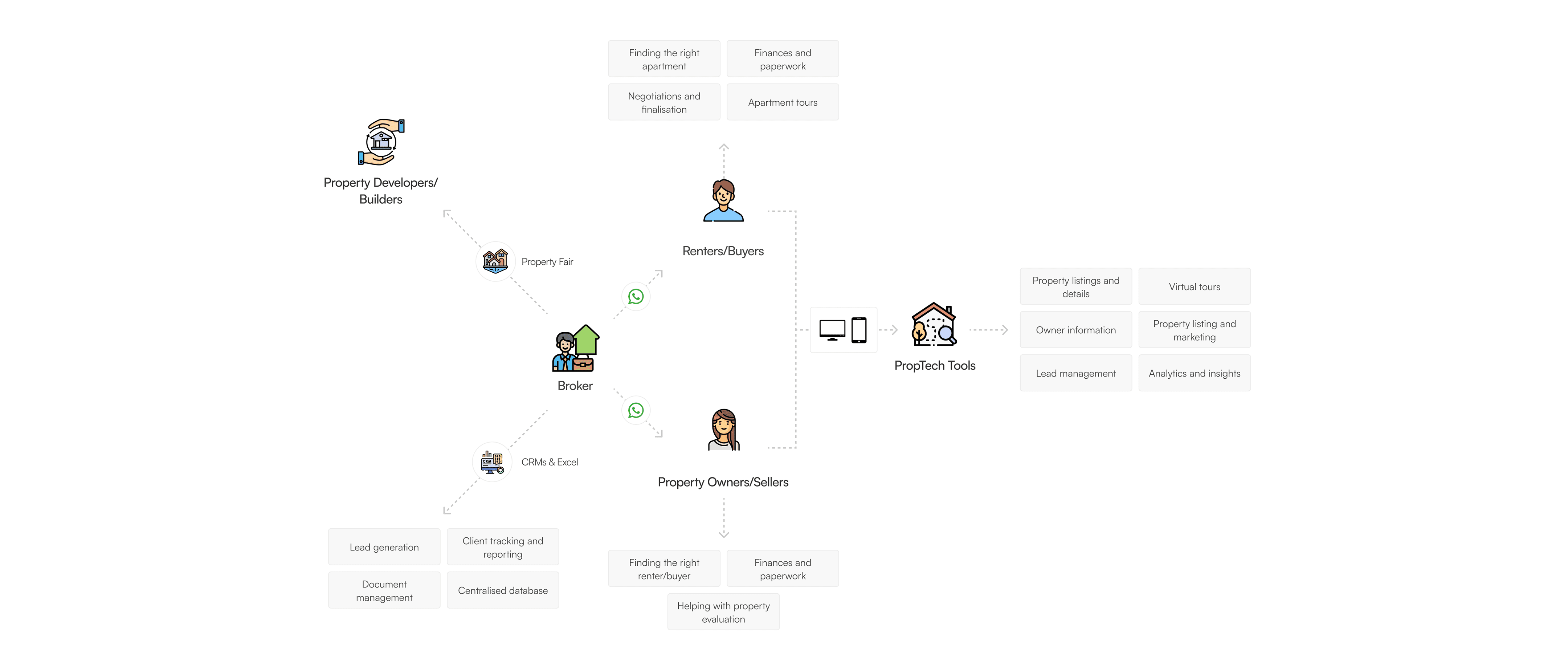
The broker sits at the centre. They interact with renters over WhatsApp, receive listings from developers at property fairs, manage leads in Excel, and coordinate with sellers, simultaneously. PropTech platforms run parallel but serve none of this workflow directly.
WHY BROKERS FIRST
All four stakeholder groups had pain points. But the broker's inefficiency cascaded across every other stakeholder's experience. Solving for the broker had the highest leverage, renters and property owners would both benefit indirectly.
Distilling the data
Four patterns emerged consistently, each pointing to a gap between how brokers work and how the tools around them are designed.
Client intent is unclear and constantly shifting
Brokers rely on memory and repeated conversations to track preferences. There is no structured record of how client needs evolve.
"What they want keeps shifting with every option they see."
FINDING 2
Workflows are disconnected
WhatsApp is the real CRM for most brokers. Communication, property details, and follow-ups live in entirely separate places.
"It's usually a mix of WhatsApp chats, notes, and Excel sheets together."
FINDING 3
Information is fragmented and hard to act on
Critical context is spread across sources with no structure, making it impossible to form a complete picture of a client without repeating the same conversations.
FINDING 4
Lead prioritisation is a guess
No visibility into lead quality means time allocation is arbitrary. Every broker interview surfaced this as a primary frustration.
"It's always a guess, how much time should a particular lead get."
Building on these insights, the key themes were mapped to identify how the system should respond, outlining the core functionalities needed to bridge existing gaps.
Preference Gathering
Giving brokers a structured, living record of how client preferences evolve, so they can act on what a client actually responds to, not just what they said at the start.
Information Management
Consolidating leads, client data, and deal context into one decision-ready system, so brokers spend time on deals, not on reconstructing information before every interaction.
Communication Co-ordination
Keeping communication tied directly to the deal record, so the context built across months of conversations stays intact and accessible, rather than scattered across external channels.
Exploring early concepts
THEME 1 - PREFERENCE GATHERING
How do we capture not just what clients say they want, but how those preferences change over time?

This theme explored how brokers understand not just what clients say they want, but how those preferences evolve throughout the property search journey. Early concepts focused on capturing richer preference signals such as changing budgets, preferred neighborhoods, non-negotiables, and browsing behaviour over time. Instead of relying on rigid match scores, the concepts aimed to provide brokers with contextual preference histories that could help them interpret latent needs using their own expertise. The final direction taken forward was a structured preference capture system combined with a timeline-based history view that helped brokers see evolving intent rather than static data snapshots.
Taken forward: A structured preference history that helps brokers understand how client needs evolve over time instead of relying on static match scores.
THEME 2 - INFORMATION MANAGEMENT
How do we give brokers a complete, decision-ready view of each client and deal without requiring them to switch tools?

This theme focused on reducing the fragmented nature of broker workflows where leads, conversations, property details, documents, and activities were spread across multiple tools. The concepts explored centralized dashboards and unified deal workspaces that could bring all critical information into a single decision-ready interface. The goal was to help brokers quickly understand the status of a client or deal without constantly switching contexts. What was ultimately taken forward was the idea of a consolidated CRM workspace that surfaces all relevant client, deal, and activity information together for faster and more informed decision-making.
Taken forward: A unified client and deal workspace that brings leads, activities, communication, and property context together in one decision-ready view.
THEME 3 - COMMUNICATION CO-ORDINATION
How do we keep communication tied to deal records rather than scattered across external channels?

This theme explored how communication could remain tied to deal records instead of being scattered across WhatsApp, calls, spreadsheets, and personal notes. The concepts focused on embedding communication directly into the CRM while preserving contextual information such as property details, preferences, and interaction history alongside conversations. Another important exploration was maintaining a chronological communication log linked to every deal to support continuity across long sales cycles. The final direction taken forward was an integrated communication experience with always-visible context panels and centralized activity histories that ensured brokers could maintain accountability and continuity throughout the client journey.
Taken forward: Communication tied directly to deal records with always-visible context panels so brokers never lose conversation history or client intent.
The impact this created
Across three key dimensions, Deal Meridian reduced fragmentation, improved broker efficiency, and created a more consistent deal tracking experience.
50%
Reduction in tool-switching
By consolidating deal status, documents, and interactions into a single dashboard.
40%
Improved deal tracking consistency
By replacing fragmented spreadsheets and email threads with a unified pipeline.
30%
Decrease in manual follow-up tracking
Through centralised deal visibility and role-based views.

Thank you for stopping by!
I’m always learning, evolving and designing with curiosity, so if you have thoughts, feedback or just want to say hi, I’d love to hear from you!
© 2026 Anushka Belsare | Created With Empathy